digital pdf guide

GI Restoration & Dysbiosis Protocol

You found the dysbiosis. Here's exactly how to treat it.
The complete clinical protocol Dr. Lundell runs for dysbiosis, SIBO, and parasites — antimicrobial selection, the 4R framework, biofilm disruption, mucosal repair, and the GI Repair Shake. From the first decision to retest through long-term maintenance, written the way he sequences it in his own practice.
What This Guide Covers

Most gut protocols fail for predictable reasons: practitioners skip Replace, run antimicrobials empirically, ignore biofilm, or stop repair too early. This guide walks through the full sequence that avoids those traps. You'll learn when to treat, what to use, how long to cycle, and what to do when the follow-up test comes back worse than baseline.

It's built around the 4R framework (Remove, Replace, Reinoculate, Repair) and grounded in culture-and-sensitivity-guided treatment, so you're matching agents to organisms rather than guessing. The evidence is here too — including the Johns Hopkins data on herbal antimicrobials versus rifaximin — alongside the clinical judgment that tells you when the lab matters and when the patient does.

What's Inside

The clinical decision algorithm — A one-page roadmap from assessment through monitoring, plus the Five Golden Rules that keep protocols from failing. 

Why and when to test — The case for the GI 360, the indications for comprehensive stool testing, and the progressive testing strategy that controls patient cost. 

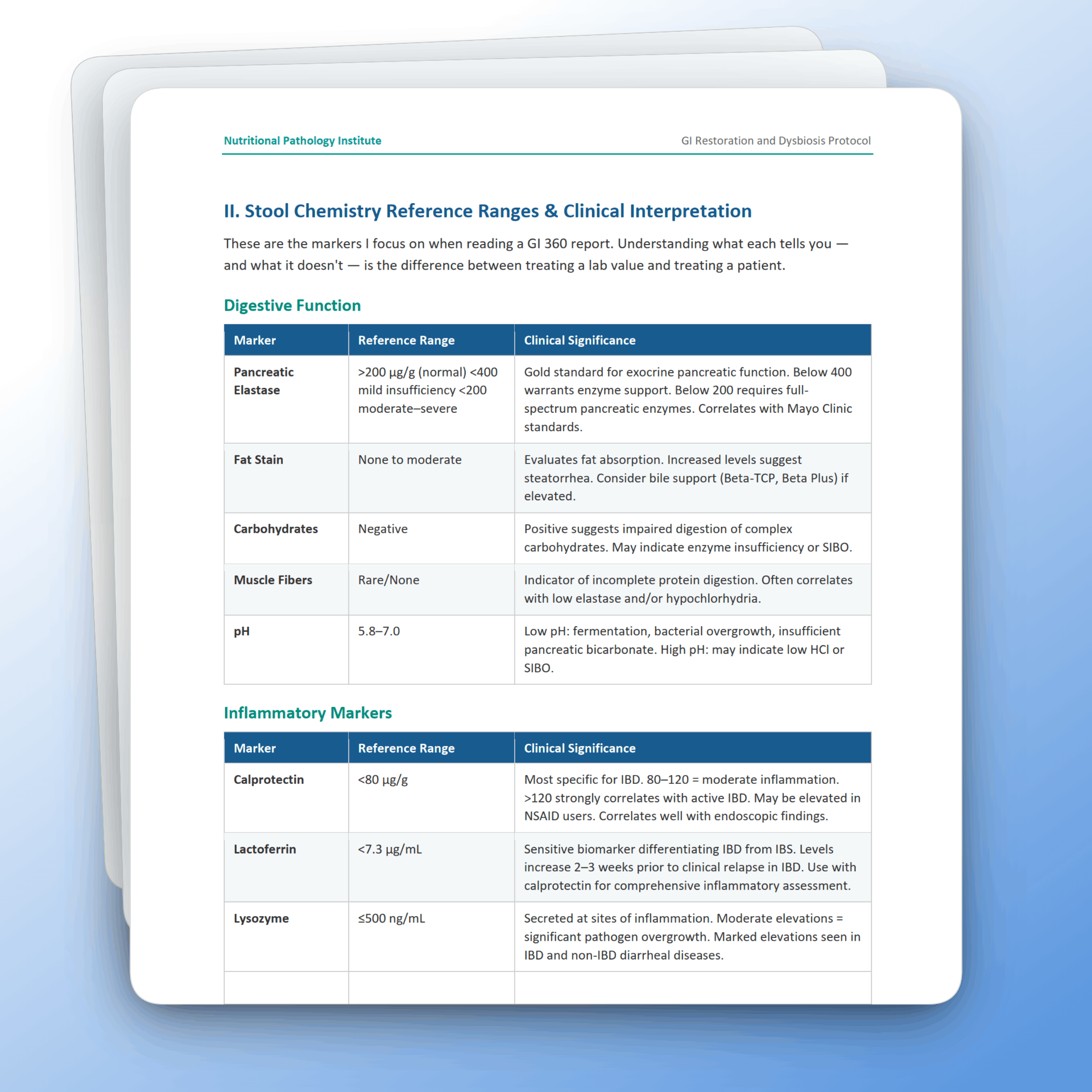
Stool chemistry interpretation — The markers that guide Replace decisions: elastase, calprotectin, lactoferrin, sIgA, beta-glucuronidase, zonulin, and what each is actually telling you. 

The 4R framework — How Remove, Replace, Reinoculate, and Repair overlap in real practice, and why sequencing them wrong is the most common point of failure. 

Replace — Restoring digestive capacity: pancreatic support, the full HCl titration protocol with the gastritis screen, bile insufficiency, and motility support.
The evidence for herbal antimicrobials — The Chedid et al. Johns Hopkins study, agent-by-agent evidence base, biofilm disruption, and methane vs. hydrogen SIBO differentiation. 

The dysbiosis protocol — The cycling structure, antimicrobial and probiotic phase tables, the parasite-specific variation, and how to manage die-off and Herxheimer reactions. 

Repair and the GI Repair Shake — The standard shake protocol, additional repair agents, a tiered anti-inflammatory approach, and the realistic repair timeline. 

Root causes and long-term strategy — Why most dysbiosis traces back to sympathetic dominance, hypochlorhydria, motility, bile, and exercise — plus retesting, maintenance, H. pylori, and pediatric considerations.

Who This Is For

Licensed practitioners — chiropractors, MDs, NDs, NPs, and others — treating dysbiosis, SIBO, parasites, or leaky gut and wanting a complete, sequenced protocol rather than a scattered set of supplement lists. Whether you're building a gut-restoration practice or refining one you already run, this is the working clinical reference Dr. Lundell uses himself.
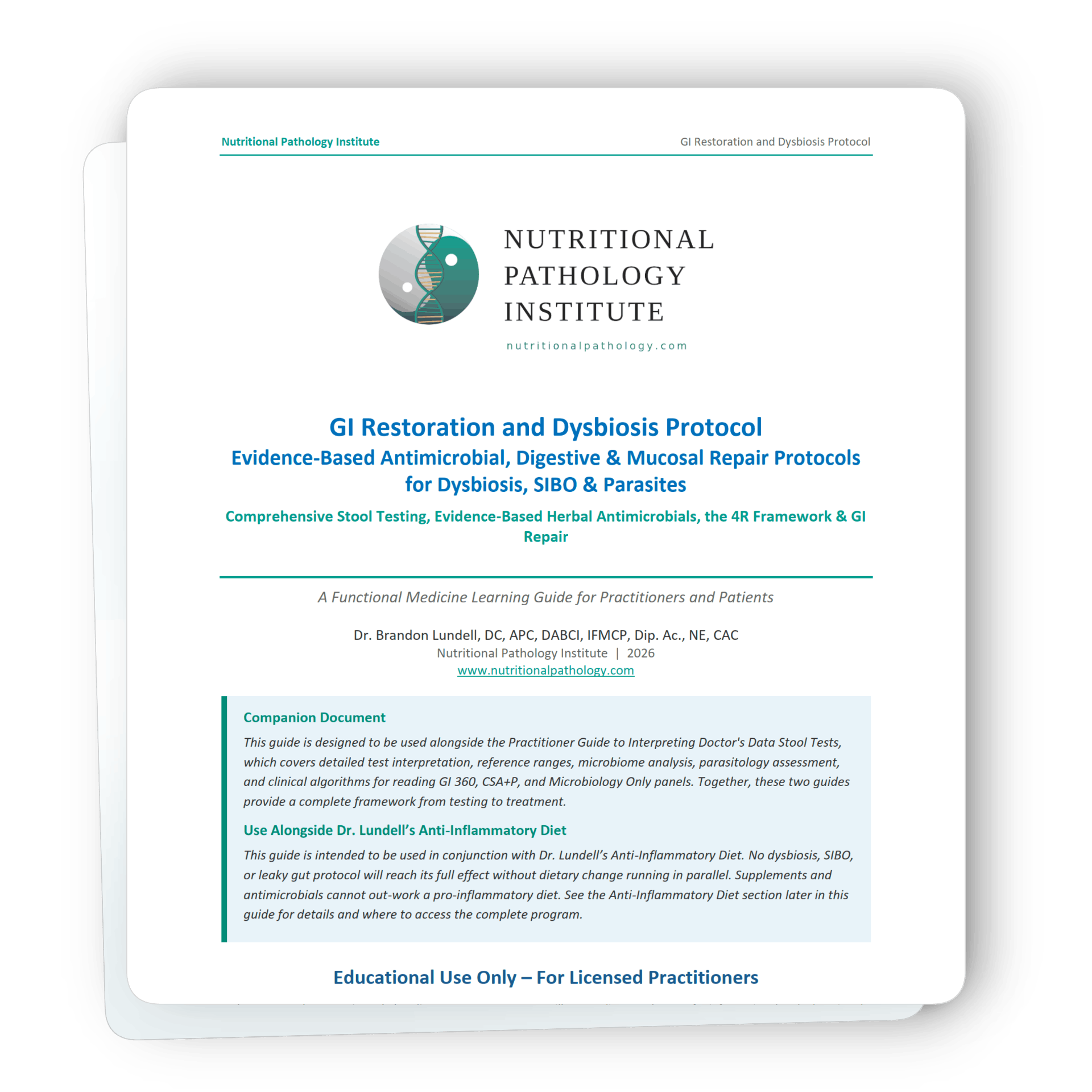
This guide pairs with the Practitioner Guide to Interpreting Stool Tests, which covers the testing side — reading GI 360, CSA+P, and Microbiology Only panels marker by marker. Together they take you from testing through treatment.
Meet Your Instructor

Dr. Brandon Lundell, DC

Dr. Brandon Lundell, DC, DABCI, IFMCP has been in clinical practice for over 20 years and has trained more than 1,000 practitioners in functional medicine nationwide. He maintains an active waiting-list practice at Harmony Healing Center in Longmont, Colorado. The protocols in these guides reflect what's being applied in practice, not theoretical frameworks.

View Dr. Lundell's CV
Patrick Jones - Course author

Get the GI Restoration 
and Dysbiosis Protocol

Complete 4R protocol · antimicrobial & repair tables
Created with