digital pdf guide

NutriSTAT Complete Diagnostic Reference Guide

Are you treating the lab value, or diagnosing the patient?
A 242-analyte interpretation reference built from over 20 years of clinical practice — optimal ranges, differential considerations, and the diagnostic reasoning behind every marker.

What This Guide Covers

The most common error in functional medicine isn't ordering the wrong labs. It's treating individual analytes without a diagnosis. A patient with elevated homocysteine doesn't have a "high homocysteine problem" — they have one of a dozen possible root causes, from B12 or folate deficiency to MTHFR variants, hypothyroidism, or PPI use. Reach for methylfolate before identifying which one applies, and you delay the intervention that would have actually worked. This pattern, what Dr. Lundell calls analyte chasing, leads to polypharmacy, patient overwhelm, and therapeutic failure, because the number on the page was never the diagnosis. It was a clue.

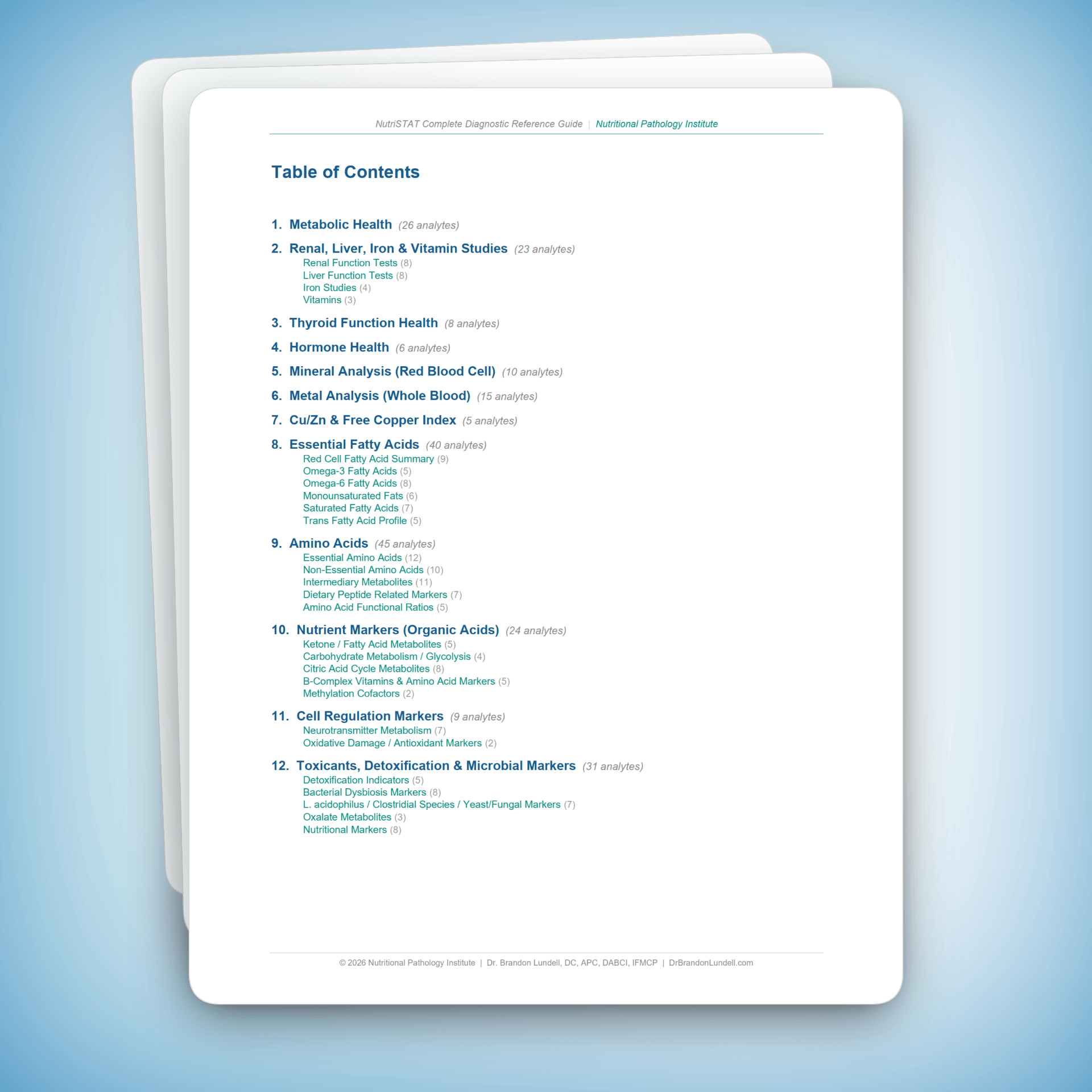
This guide gives you a structured way to work through that process for 242 analytes across 12 panels: metabolic, renal, liver, iron, vitamins, thyroid, hormones, minerals, metals, essential fatty acids, amino acids, organic acids, and toxicant/microbial markers. For each one, you get the optimal range (narrower than the standard lab range, set at the 20th–80th percentile of the reference population), a clear elevated/decreased differential, a functional medicine correlation, and nutraceutical considerations tied to root cause; not to the value in isolation. You'll be able to look at a panel of abnormal values and group them into a pattern before you reach for a single supplement.

What's Inside

Metabolic Health (26 analytes)
The core metabolic panel — glucose regulation, lipids, and inflammatory markers — read together rather than in isolation, with differentials for both elevated and depressed values.

Renal, Liver, Iron & Vitamin Studies (23 analytes)
Renal function, liver function, iron studies, and core vitamin markers in one section, so organ-system screening doesn't require flipping between four separate references.

Thyroid Function Health (8 analytes)

Full thyroid panel interpretation beyond TSH alone, with the differentials that explain why two patients with the same TSH can have completely different clinical pictures.

Hormone Health (6 analytes)
Core hormone markers with the cross-system context — adrenal, thyroid, metabolic — that determines what's actually driving an abnormal result.

Mineral Analysis (RBC) (10 analytes)
Red blood cell mineral status, which reflects tissue-level stores more accurately than serum values for most of these markers.

Metal Analysis (Whole Blood) (15 analytes)
Whole blood heavy metal and trace element assessment, with differentials separating toxic burden from nutrient-mineral antagonism.
Cu/Zn & Free Copper Index (5 analytes) 
The copper-zinc relationship and free copper calculation — a pattern that gets missed when these are read as standalone values. 

Essential Fatty Acids (40 analytes) 
Red cell fatty acid summary, omega-3s, omega-6s, monounsaturated, saturated, and trans fatty acid profiles — the full lipid membrane picture, not just an omega-3 index. 

Amino Acids (45 analytes) 
Essential and non-essential amino acids, intermediary metabolites, dietary peptide markers, and functional ratios — protein metabolism mapped from intake through utilization. 

Nutrient Markers (Organic Acids) (24 analytes) 
Ketone and fatty acid metabolites, carbohydrate metabolism, citric acid cycle intermediates, B-complex markers, and methylation cofactors — the organic acid panel read as connected metabolic pathways. 

Cell Regulation Markers 
(9 analytes) Neurotransmitter metabolism and oxidative damage/antioxidant markers, for patients where the clinical picture points upstream of the obvious panels. 

Toxicants, Detoxification & Microbial Markers (31 analytes)
Detoxification indicators, bacterial dysbiosis markers, yeast and clostridial species, oxalates, and nutritional markers — the section most likely to reframe a "mystery" case.

Who This Is For

Licensed practitioners — chiropractors, MDs, NDs, NPs, and similar — who order functional and conventional labs and want one consistent interpretation framework instead of switching references for every panel. This works as a standalone desktop reference for day-to-day chart review.
Meet Your Instructor

Dr. Brandon Lundell, DC

Dr. Brandon Lundell, DC, APC, DABCI, IFMCP has been in clinical practice for over 20 years and has trained more than 1,000 practitioners in functional medicine nationwide. He maintains an active waiting-list practice at Harmony Healing Center in Longmont, Colorado. The interpretation framework in this guide is the one he uses in his own practice every day, not a theoretical model.

View Dr. Lundell's CV
Patrick Jones - Course author

Get The NutriSTAT Complete Diagnostic Reference Guide

242 analytes · 107 pages · ranges narrower than conventional labs
Created with